


EYFS
The Ilsleys - Arctic Class Teacher: Miss Parsons
Hampstead Norreys - Buzzards Class Teacher: Mrs Styles and Mr Edwards
About EYFS
Our Reception children enjoy their own specially designed outdoor learning area, completely enclosed and separate from the rest of the school. Here, they can immerse themselves in role play, get creative in the mud kitchen, explore the sandpit and water area, and discover many other opportunities to learn and grow. We also take advantage of our outdoor classroom on the top field, giving children even more space to flourish.
Starting Reception Information
Our EYFS vision
- Intent
- Implementation
- Impact
Intent, Implementation and Impact Document
In Reception, children learn through a rich blend of play‑based activities, continuous provision, and enhanced provision linked to our topic. Our indoor and outdoor environments are carefully designed to spark curiosity and independence, with a wide variety of language-rich displays for children to observe, use, and interact with. Children enjoy a balance of open play, where they follow their own interests, and adult‑led activities that introduce new skills and ideas. Throughout the week, they also complete challenges linked to the seven areas of learning, helping them practise, apply, and deepen their understanding in meaningful ways.
High‑quality language and questioning are modelled and facilitated by adults every day. Staff consistently maximise opportunities for rich interactions - including during informal moments and care routines - and proactively engage children who may be quieter or less confident. Teachers plan, assess, and adapt learning carefully to ensure that no teaching opportunity is missed.
Early Reading and Writing
Early Reading
Early reading is a key strength in EYFS and the foundation of all learning. Children engage daily with high‑quality fiction and non‑fiction texts, guided reading sessions, and rich vocabulary experiences. They take home a new reading book every day, along with keywords and sight words to practise.
Phonics teaching is high‑profile, carefully sequenced, and monitored by the Phonics Lead, who tracks progress, conducts gap analysis, and ensures children are grouped appropriately. Targeted interventions and home support accelerate progress, ensuring every child becomes a confident early reader.
Reading, including the teaching of systematic, synthetic phonics is taught from the beginning of Reception, when children join our school. Children are taught to read, using the West Berkshire approved Phonics scheme called ‘Flying Start to Letters and Sounds’.
Phonics resources
Each year group works within particular phases.
- Phases 1, 2, 3 and 4 are taught in Reception.
- Phase 5 is taught throughout Year 1.
The pronunciation of phonics sounds when teaching children how to read is crucial. If you would like to learn how to pronounce the sounds, please click on the link here: https://www.youtube.com/watch?v=UCI2mu7URBc
Other websites you may find useful are the Phonics Play https://www.phonicsplay.co.uk/ and Teach your Monster how to Read https://www.teachyourmonster.org/.
Intent
At Hampstead Norreys and The Ilsleys Primary Schools, we aim to deliver high-quality phonics teaching to provide a solid base for all children to build on in literacy as they progress through school. We want to help children to become fluent and confident readers, enjoying reading for both pleasure and information.
The government has revised the core criteria for effective systematic synthetic phonics teaching programmes and we have chosen one of these new validated programmes to further enhance what we already do.
Systematic synthetic phonics means regularly using methods and resources which are consistent and proven to ensure a structured route for most children to meet or exceed the expected standard in the Year 1 phonics screening check, as well as providing sufficient support for children in Early Years and Key Stage 1 to become proficient readers.
We use the West Berkshire ‘A Flying Start to Letters & Sounds’ programme. The four key ambitions of the programme are for children to develop good language skills and a wide vocabulary; to foster a love of reading; to provide the skills required to read independently; to secure the physical skills necessary for writing in order to record what they have learnt and write creatively.
Children throughout Reception and Key Stage 1 take part in daily phonics sessions, in small groups which are appropriate to their level and pace of learning.
Phonics teaches children how to match graphemes (written letters or letter groups) to phonemes (the sounds that we say and hear). Children learn to read by segmenting the sounds they see in words then blending them together; children learn to spell by segmenting and writing the sounds in a given word. The sounds of the English language are taught progressively, in a systematic order. Phase 1 is taught throughout Reception and KS1; in Reception, children are taught Phases 2, 3 and 4; in Year 1, children move onto Phase 5 and prepare for the statutory Phonics Screening Check.
- Phase 1 objective: develop life-long learners who can tune into sounds, have quality conversations and love books.
- Phase 2, 3 and 4 objectives: recognise and articulate sounds that can be blended for reading and segmented for spelling.
- Phase 5 objective: understand that there are alternative ways to say, read and spell words.
The teaching sequence follows a set pattern – revise, teach (I do it), practise (you do it) and apply (we do it again).
“A Flying Start with Letters & Sounds has been designed to promote rapid progress through the phases. Fluent readers build up their ability to read familiar and unfamiliar words at speed. Then once they can decode unfamiliar words with ease they can then begin to develop their comprehension of what they have read which further supports their understanding of language.”
To promote confidence and pleasure in reading, children will take home books which are fully decodable and matched to their level of phonics attainment.
While teaching of sounds is thorough and fast-paced, our programme allows for consolidation spot check days and weeks when learning is reviewed and any gaps in attainment identified. Children’s progress is tracked weekly to give teachers a clear picture of attainment, to allow them to adapt planning and identify and put into place appropriate support if required.
Termly assessments and tracking also allows for the regular monitoring of progress.
Disadvantaged children and those with SEND are given full access to the curriculum. Teachers use a range of strategies to enable all children to become successful readers including:
- Small group phonics support/opportunities
- Extra time given to flashcards to reinforce learning of phonemes
- Using a range of learning styles and provide multi-sensory experiences.
- Encouraging use of sound/word mats to support writing in phonics
Implementation
What phonics looks like in lessons:
- Whole school discrete phonics/spelling daily for 30 minutes.
- A balance of blending and segmenting, speaking and listening skills taught across a week which are lively, interactive and investigative.
- Strategies taught to identify and decode `tricky words’ within the English language
- Multi-sensory approach to the teaching of phonics, to support effective delivery of phonics.
- Groups differentiated to ensure all meet their full potential.
- Every lesson begins with a revisit and review of previous learning.
- Every lesson ends with application to reading or writing.
- Good pace of the lesson keep children engaged throughout the lesson.
- Appropriate level of challenge for each child.
- A mixture of whole class, group and individual work.
- Dots and lines used for phonemes for sound buttons.
- Handwriting policy and correct letter formation will be reinforced through phonics sessions.
Some children benefit from a little extra practice, so we offer ‘Turbo Time’ sessions to help them feel confident and secure in their phonics learning. These sessions revisit or re‑teach sounds and give children another chance to practise and embed what they’ve learned. Turbo Time is part of our validated scheme, ‘A Flying Start to Letters and Sounds’.
What phonics looks like outside lessons:
- Phonics skills are applied and embedded in reading and writing tasks across the curriculum.
- Learning environment will support children in their learning and application of phonics e.g. word mats, word lists, display.
- A wide range of high-quality texts used to apply phonic awareness, for example in guided reading and story time.
- Opportunities for learning phonics presented throughout the day, for example during challenge time.
- Where interventions are required, they are put into place to fill gaps and meet individual children’s needs.
- Regular (half-termly) staff meetings to ensure consistency in assessment and to review children’s progress.
- Regular staff training.
- Parents informed of phonics learning through meetings with parents.
Impact
Formative Assessment
- Verbal Feedback – the vast majority of feedback is in conversation with the pupil, allowing misconceptions to be spotted and effectively addressed at an early stage.
- Observations and assessments from each lesson to inform next step planning.
Summative Assessment
- At the end of each phonics session, teachers identify any children who would benefit from additional practice. These pupils take part in a Turbo Time session later that afternoon to revisit the sound taught.
- Every half term, teachers assess children’s recognition of the sounds covered and record whether each sound is secure. This information is shared with the Phonics Lead, who completes a GAP analysis to inform future teaching and next steps. Assessment outcomes are also shared with parents so they can support phonics learning at home.
- Children take home high‑frequency words to learn by sight. These complement their phonics learning and help them develop fluency and confidence as early readers.
- All Year 1 children take the ‘Phonics Screening Check’ - a statutory assessment required by legislation. Those who do not meet the pass mark will be given support and intervention programmes in year two to provide them with sufficient knowledge and understanding to re-take the ‘Phonics Screening Check’ and obtain a pass mark. Those children who do not obtain the required level set by the ‘Phonics Screening Check’ will receive phonics teaching in the first term of year three – which will be further supported throughout the year and across key stage two with a phonics and/or spelling intervention programme.
Practice ‘Phonics Screening Check’ to take place from February to identify areas for future learning.
How can I help me child with reading?
Below you will find some resources which can help you with supporting your child with their reading! If you have any further questions, please do not hesitate to contact your class teacher.
First 100 high frequency words
Sound mats – phases 2-5 (no phase 4)
Tricky word sound mats – phases 2 - 5
Early Maths
In Reception, we build early mathematical understanding through play‑based, practical, and language‑rich experiences. Children explore maths daily through hands‑on activities, continuous provision, and purposeful interactions with adults.
We focus on developing strong number sense, including recognising numbers, counting with accuracy, comparing quantities, and beginning to understand addition and subtraction through real-life contexts. Children learn to subitise, spot patterns, and talk about their mathematical thinking using precise vocabulary.
Alongside number, children explore shape, space, and measure through play - building, sorting, comparing size, exploring capacity, and using positional language. Adults model mathematical language and extend learning through questioning and guided activities.
Top tips for supporting your child with number at home
A Challenging and Enriched Curriculum
Our curriculum is ambitious, carefully sequenced, and enriched with real‑life experiences, exploration of the wider world, and cross‑curricular opportunities. Children develop a broad and deep understanding of the world around them, building the foundations needed for future learning.
The learning environment is rich in materials that promote vocabulary, early writing, mathematical thinking, creativity, and problem‑solving. Early writing is modelled, scaffolded, encouraged, and celebrated, with clear evidence of progress seen in children’s Unaided Writing books.
Rigorous Assessment and Responsive Teaching
Adults know each child exceptionally well. Precise assessment informs teaching, groupings, and interventions, ensuring every child - including those with SEND or additional needs - makes strong progress. Teachers can articulate children’s progress in detail and adapt learning swiftly to meet individual needs.
Children in EYFS are tracked closely across all seven areas of learning, ensuring rapid progress from their starting points.
Personal Development and Well‑Being
Children learn in a safe, nurturing, and inclusive environment where curiosity, independence, resilience, and collaboration are actively encouraged. They develop positive attitudes to learning, celebrate diversity, and learn to value and respect others. Staff build strong relationships with every child and proactively support those who may engage less readily, ensuring each child feels seen, valued, and supported throughout the day.
We enrich children’s personal development through a wide range of school trips, visitors, and hands‑on experiences that bring learning to life. We are fortunate to offer so many opportunities that broaden children’s understanding of the world and deepen their learning in meaningful, memorable ways.
Strong Partnerships with Parents
We believe that strong relationships with families are essential for children’s success. Through Tapestry, parents receive regular updates and are encouraged to support learning at home. Daily reading books, keywords, and home learning activities help strengthen this partnership and reinforce progress.
Parents are kept informed and involved in their child’s learning through a range of opportunities:
- Parent Welcome - At the end of the day, parents are invited into the classroom to look at their child’s learning and speak with the class teacher.
- Celebration Assemblies - Every Friday, parents join our whole‑school assembly where children proudly share a piece of learning from the week.
- Parents’ Evenings - Once each term, parents meet with the class teacher to discuss progress, next steps, and how we can work together to support learning.
These regular touchpoints ensure that families feel informed, connected, and confident in their child’s Early Years journey.
Stay and Play
We offer Stay and Play sessions for children under four, providing a welcoming introduction to our Early Years environment. These sessions are a wonderful opportunity for new starters or families considering our school to explore the setting, meet the staff, and become familiar with the routines. Children gain confidence in the environment and build early relationships with the adults they may be working with from September, helping to ensure a smooth and positive transition into school.
Leadership and Impact
Leaders are highly effective in quality‑assuring the impact of education and care in the Early Years. They monitor provision closely, ensuring rapid and sustained improvements where needed. As a result, children typically achieve well, with above‑average proportions reaching a Good Level of Development.
Children leave EYFS as confident, curious, independent learners, fully prepared for Key Stage 1. They have strong foundations in early reading, writing, mathematics, communication, and personal development - skills that enable them to flourish throughout their school journey and beyond.
Reception Parent Packs
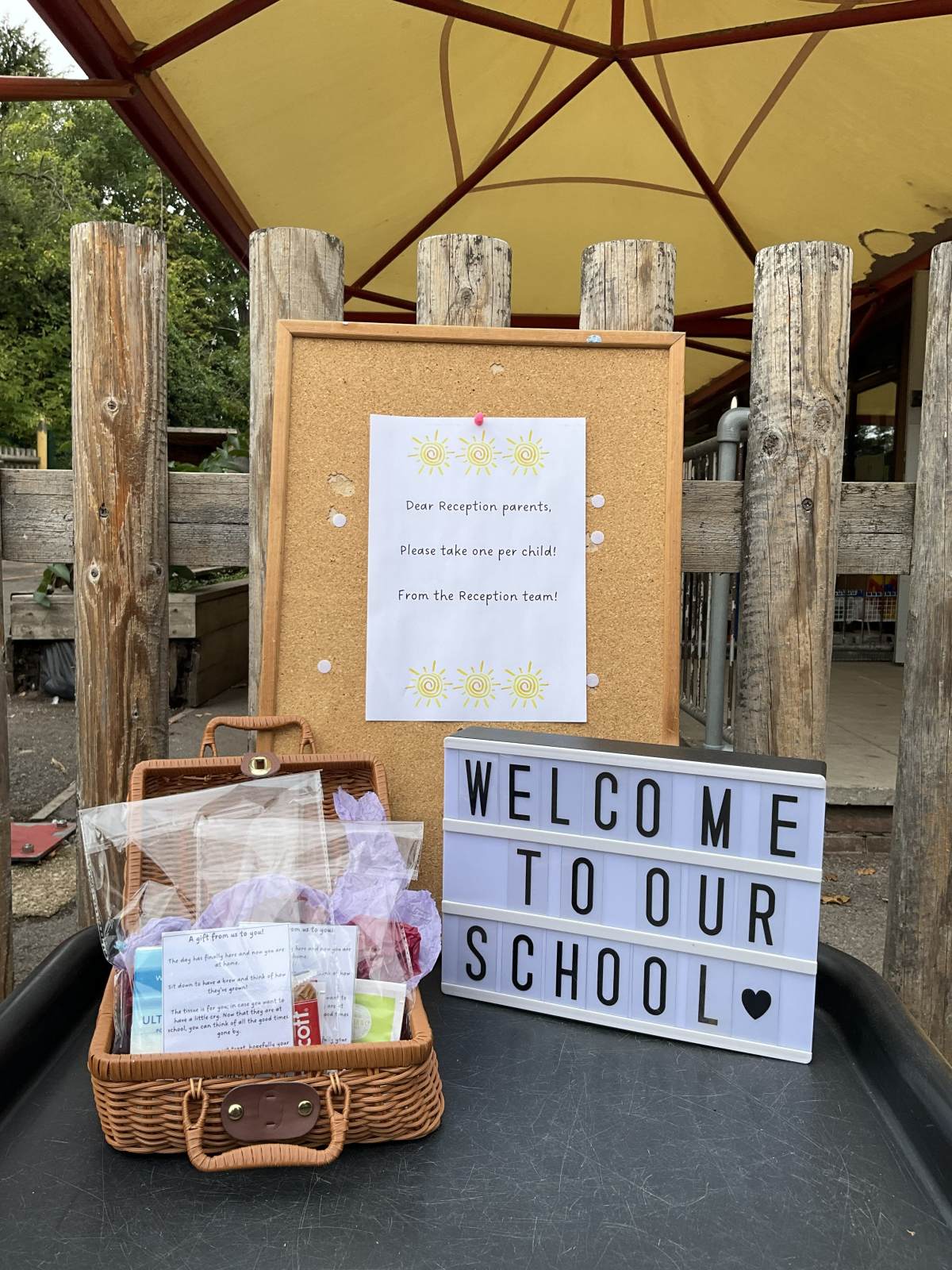
On their child’s first day of school, each new Reception family receives a small parent pack containing a biscuit, tissues, tea bags and a special poem. Although it is a simple gesture, the pack plays an important role in helping us to build positive relationships with families from the very beginning.
Starting school is a huge milestone, not only for the child but also for their parents and carers. The first day can bring excitement, pride and sometimes a few tears! The pack is a thoughtful way of showing families that we understand this transition and are there to support them every step of the way.
These small acts of kindness help to create a welcoming, caring and inclusive school community, while building trust and strong relationships between home and school. It sends the message that every family is valued and that we are all working together to help their child settle, feel safe and thrive.
EYFS Long Term Plan 2026-2027
EYFS Progression Document


